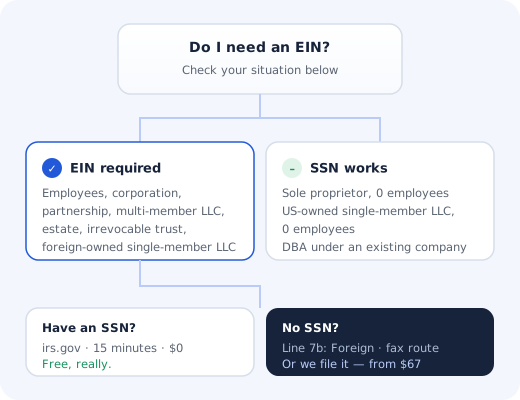
Do I need an EIN?
You need an EIN if you pay employees, operate a corporation or partnership, file excise or withholding returns, or administer an estate or an irrevocable trust. A sole proprietor with 0 employees files under a Social Security Number.
The IRS never decides this by business size or by revenue. It decides by which federal return the entity files. Every return in the right-hand column below carries an EIN field with no SSN alternative. Find the row that matches your situation.
| Your situation | EIN needed | The federal trigger |
|---|---|---|
| You pay 1 or more employees | Yes | Forms 941, 940, and W-2 are all filed under an EIN |
| You formed a C corporation or an S corporation | Yes | Form 1120 and Form 1120-S are filed under an EIN |
| You formed a partnership or a multi-member LLC | Yes | Form 1065 is filed under an EIN |
| You own a single-member LLC and you are not a US person | Yes | Form 5472 is filed under the LLC's own EIN |
| You file excise tax returns | Yes | Form 720 and Form 2290 are filed under an EIN |
| You withhold tax on income paid to a non-resident alien | Yes | Form 1042 is filed under an EIN |
| You run a non-profit organization | Yes | Form 1023 and Form 990 are filed under an EIN |
| You administer an estate with $600 or more of gross income | Yes | Form 1041 is filed under the estate's EIN |
| You are trustee of an irrevocable trust | Yes | Form 1041 is filed under the trust's EIN |
| You sponsor a Keogh retirement plan | Yes | The plan reports under an EIN |
| You are a sole proprietor with 0 employees | No | Schedule C accepts the owner's Social Security Number |
| You are a US owner of a single-member LLC with 0 employees | No | The IRS disregards the LLC and taxes it on Schedule C |
| You trade under a DBA owned by an existing company | No | The DBA reports under the parent entity's EIN |
| You are a grantor of a revocable living trust and still living | No | The trust reports on the grantor's Form 1040 |
Source: IRS, Do You Need an EIN, and the Form SS-4 instructions, verified July 2026.
10 rows read Yes and 4 rows read No. A single Yes in your column settles it: the IRS issues one EIN per entity, and one EIN covers every activity that entity carries out.
Prefer to answer a few questions instead? Run the free checker below. It reads your verdict and the application path that fits, entirely in your browser.
Guidance only, based on the answers you give. This tool runs entirely in your browser, stores nothing, and is not affiliated with the IRS. The IRS charges $0 for the EIN through every filing method.
When does the IRS require an EIN?
The IRS requires an EIN when the entity files a return that has no SSN field: Form 941, Form 1120 for corporations, Form 1065 for partnerships, Form 720 for excise, Form 1041 for estates, and Form 990 for non-profits.
Payroll starts the clock
The first employee makes the EIN mandatory. Form 941 reports payroll tax every quarter, 4 times a year. Form 940 reports federal unemployment tax once a year. Form W-2 reports each employee's wages. All 3 forms open with the employer's EIN.
Line 13 of Form SS-4 takes 3 numbers: agricultural, household, and other employees expected in the next 12 months. Enter 0 in all 3 boxes when the entity hires nobody. Line 14 elects Form 944, the annual filing available at $1,000 or less of expected employment tax.
Entity structure decides it before revenue exists
A corporation needs an EIN on day 1, at $0 of revenue and 0 employees, because Form 1120 has no SSN field. A partnership and a multi-member LLC need one for the same reason: Form 1065 issues a Schedule K-1 to each partner and identifies the partnership by EIN.
Line 8b of Form SS-4 records the member count, and that single number sets federal tax treatment. 1 member defaults to a disregarded entity. 2 or more members defaults to a partnership.
Excise, withholding, and retirement plans
Form 720 reports quarterly excise tax. Form 2290 reports heavy highway vehicle use tax on vehicles of 55,000 pounds or more. Form 1042 reports tax withheld on income paid to a non-resident alien. A Keogh plan reports under an EIN. Each of these 4 filings requires one.
Estates and trusts
An estate needs an EIN once gross income reaches $600, the threshold that triggers Form 1041. An irrevocable trust needs one from the day it becomes irrevocable, which for a revocable living trust is the grantor's date of death. Line 3 of Form SS-4 names the executor or trustee.
Read the details on the EIN for estate page and the EIN for trust page.
Source: IRS Form SS-4 instructions, the Form 1041 instructions for the $600 gross income threshold, and the Form 2290 instructions for the 55,000-pound threshold, verified July 2026.
Which entity types need an EIN?
Corporations, S corporations, partnerships, multi-member LLCs, non-profits, estates, irrevocable trusts, and foreign-owned single-member LLCs all need an EIN. Sole proprietorships and US-owned single-member LLCs with 0 employees do not.
| Entity type | EIN needed | Federal return | Note |
|---|---|---|---|
| Sole proprietorship, 0 employees | No | Schedule C with Form 1040 | Form W-9 accepts the owner's SSN |
| Sole proprietorship, 1+ employees | Yes | Schedule C plus Forms 941 and 940 | The EIN opens the payroll tax account |
| Single-member LLC, US owner, 0 employees | No | Schedule C with Form 1040 | Banks still ask for an EIN |
| Single-member LLC, non-US owner | Yes | Form 5472 with a pro-forma Form 1120 | The LLC files under its own EIN every year |
| Multi-member LLC | Yes | Form 1065 | Line 8b of Form SS-4 takes the member count |
| C corporation | Yes | Form 1120 | Required at 0 employees and $0 revenue |
| S corporation | Yes | Form 1120-S | Form 2553 elects the status after the EIN issues |
| Partnership | Yes | Form 1065 | Each partner receives a Schedule K-1 |
| Non-profit corporation | Yes | Form 990 | The EIN comes before the Form 1023 application |
| Estate of a deceased person | Yes | Form 1041 | Triggered at $600 of gross income |
| Irrevocable trust | Yes | Form 1041 | A revocable trust turns irrevocable at the grantor's death |
| Revocable living trust, grantor living | No | The grantor's Form 1040 | The trust reports under the grantor's SSN |
Source: IRS entity classification rules and Form SS-4 line 9a, verified July 2026.
The foreign-owned single-member LLC is the row people miss. The IRS disregards the LLC for income tax and still requires it to file Form 5472 with a pro-forma Form 1120 every year, under the LLC's own EIN. The penalty for a missed Form 5472 starts at $25,000 per year.
Source: IRC section 6038A(d) and the IRS Form 5472 instructions, verified July 2026.
Walk the LLC route step by step on the EIN for sole proprietorship page, or read the non-profit sequence on the EIN for nonprofit page.
When is an EIN optional?
An EIN is optional for a US sole proprietor with 0 employees and for a US-owned single-member LLC with 0 employees. Both file Schedule C under the owner's Social Security Number. Both request one by choice for banking and privacy.
Optional is not the same as pointless. 3 concrete reasons move people from optional to filed.
Form W-9 stops carrying your SSN. Every client who pays $600 or more sends a Form 1099-NEC and asks for a Form W-9 first. An EIN fills that box instead of 9 digits tied to your identity.
The bank account separates from your personal account. US business accounts ask for the EIN and the CP-575 letter. Mixing business income into a personal account weakens the liability separation an LLC exists to create.
Hiring stops being a 6-to-11-week delay. The day you pay employee 1, Form 941 needs an EIN. Mail applications take 6 to 11 weeks. Holding the number in advance costs $0.
A missing TIN on Form W-9 exposes the payment to backup withholding at 24%. The EIN closes that gap and costs $0 from the IRS.
Source: IRS Form W-9 instructions and IRC section 3406, verified July 2026.
Do I need an EIN to open a US business bank account?
Yes. US banks require the 9-digit EIN and the IRS CP-575 confirmation letter before opening a business account. The bank matches the legal name on the CP-575 against the state formation document, character for character.
Federal customer identification rules require a taxpayer identification number for every business account. The EIN is that number. The CP-575 is the document that proves the IRS issued it, and the IRS prints exactly 1 CP-575 per EIN.
Mercury, Relay, Wise, Stripe, PayPal, and Amazon each run this check during onboarding. A name mismatch on line 1 of Form SS-4 surfaces here, months after filing, and the fix is a fresh application. Lose the letter and the IRS replaces it with a 147C letter on request, never with a second CP-575.
See what arrives and what banks read on the EIN confirmation letter page. Already had an EIN and cannot find it? The lost ein number page covers recovery.
Do I need an EIN if I have no SSN?
The same 10 situations apply with or without an SSN. The IRS issues EINs to responsible parties who hold no SSN and no ITIN. Line 7b of Form SS-4 takes the word Foreign, and the form goes by fax.
| Channel | Number | Who uses it |
|---|---|---|
| IRS fax, US-based entity | 855-641-6935 | The entity has a US business address |
| IRS fax, international | 855-215-1627 | The entity has no US business address |
| IRS international phone line | 267-941-1099 | International applicants calling the IRS directly |
Source: IRS, verified July 2026.
2 facts settle the questions that follow. The IRS asks for no Social Security Number on line 7b, and the IRS asks for no identity document anywhere across the 18 fields of Form SS-4. No passport. No US visit. Line 7b carries 1 word, and the IRS accepts it.
The IRS online assistant rejects this route at the responsible-party screen, because the tool validates line 7b against SSN and ITIN records. That validation is the whole reason the fax line exists. The fax carries no tracking number and no status page.
An EIN is not an ITIN, and the 2 numbers answer different questions. The ein vs itin page explains which one your situation calls for. The complete no-SSN route runs step by step on the apply for EIN without SSN page.
When do you need a new EIN for an existing business?
You need a new EIN when the entity itself changes: a sole proprietorship incorporates, a sole proprietor takes on a partner, a partnership incorporates, or a corporation receives a new state charter. Name and address changes keep the same EIN.
| The change | New EIN | The rule |
|---|---|---|
| A sole proprietorship incorporates | Yes | The corporation is a new entity to the IRS |
| A sole proprietor takes on a partner | Yes | The partnership is a new entity |
| A sole proprietor enters bankruptcy proceedings | Yes | The IRS assigns the bankruptcy estate its own number |
| A partnership incorporates | Yes | The corporation is a new entity |
| One partner takes over and runs the business alone | Yes | The sole proprietorship is a new entity |
| A corporation receives a new charter from the state | Yes | The new charter creates a new entity |
| You change the business name | No | The EIN stays with the entity for its whole life |
| You move the business to a new address | No | Report the move on Form 8822-B |
| You open a second or third location | No | One EIN covers every location of one entity |
| A corporation elects S corporation status | No | Form 2553 keeps the same EIN |
| The responsible party changes | No | Report it on Form 8822-B within 60 days |
Source: IRS, Do You Need a New EIN, verified July 2026.
The pattern behind all 11 rows is one question: did a new legal entity come into existence? A new entity gets a new number. The same entity under a new name, a new address, or a new tax election keeps the number it already has for the rest of its life.
Line 18 of Form SS-4 asks whether the entity ever received an EIN before. Answer it honestly. A second EIN issued to one entity creates 2 open tax accounts under 1 company, and the IRS corrects that by mail.
Who does not need an EIN at all?
4 groups need no EIN: a US sole proprietor with 0 employees, a US-owned single-member LLC with 0 employees, a DBA trading under a company that already holds one, and a revocable living trust while the grantor is alive.
A DBA is the clearest of the 4. A DBA is a trade name registered with a state or a county, not a legal entity, and the IRS issues 0 EINs to trade names. Line 2 of Form SS-4 records the trade name under the legal name on line 1, and the EIN attaches to line 1. Run 5 DBAs under 1 LLC and all 5 report under 1 EIN.
A revocable living trust is the second. While the grantor is alive, the trust's income reports on the grantor's Form 1040 under the grantor's SSN. The requirement starts at the grantor's death, when the trust turns irrevocable and files Form 1041.
Read the trade-name rule in full on the EIN for DBA page.
What does an EIN cost once I need one?
An EIN costs $0. The IRS charges nothing for Form SS-4 and nothing for the number, through all 4 filing methods. An EIN costs $0 in year 2 and every year after, because an EIN never renews and never expires.
| Filed by | Price | Filing guarantee in writing | Year 2+ |
|---|---|---|---|
| Yourself, direct to the IRS | $0 | Not stated | $0 |
| einnumber.co Standard | $67 | Filed by fax within 5 business days or the filing is free | $0 |
| einnumber.co Fast | $97 | Filed and the IRS call made within 24 hours, guaranteed, or the filing is free | $0 |
| Northwest | $200 | Not stated | $0 |
| ZenBusiness | $99 | Not stated | $0 |
| Rocket Lawyer | $59.99 | Not stated | $0 |
Competitor prices verified July 2026. Northwest reflects the no-SSN rate.
Read this before paying anyone, including us. Holding an SSN means the IRS issues your EIN at irs.gov in 15 minutes for $0, Monday to Friday, 7 a.m. to 10 p.m. Eastern. The $67 exists for the applicants that tool blocks: a paper Form SS-4, a fax line with no tracking, and 18 fields that have to be right the first time.
einnumber.co files by fax within 5 business days of receiving your completed details on Standard, and within 24 hours on Fast. Business days run Monday to Friday excluding US federal holidays. You receive the 9-digit EIN and the official IRS CP-575 letter: 12–14 business days total on Standard, under a week on Fast.
Compare every route on the how much does an EIN cost page, read the free path in full on the free EIN number page, or get started now.